
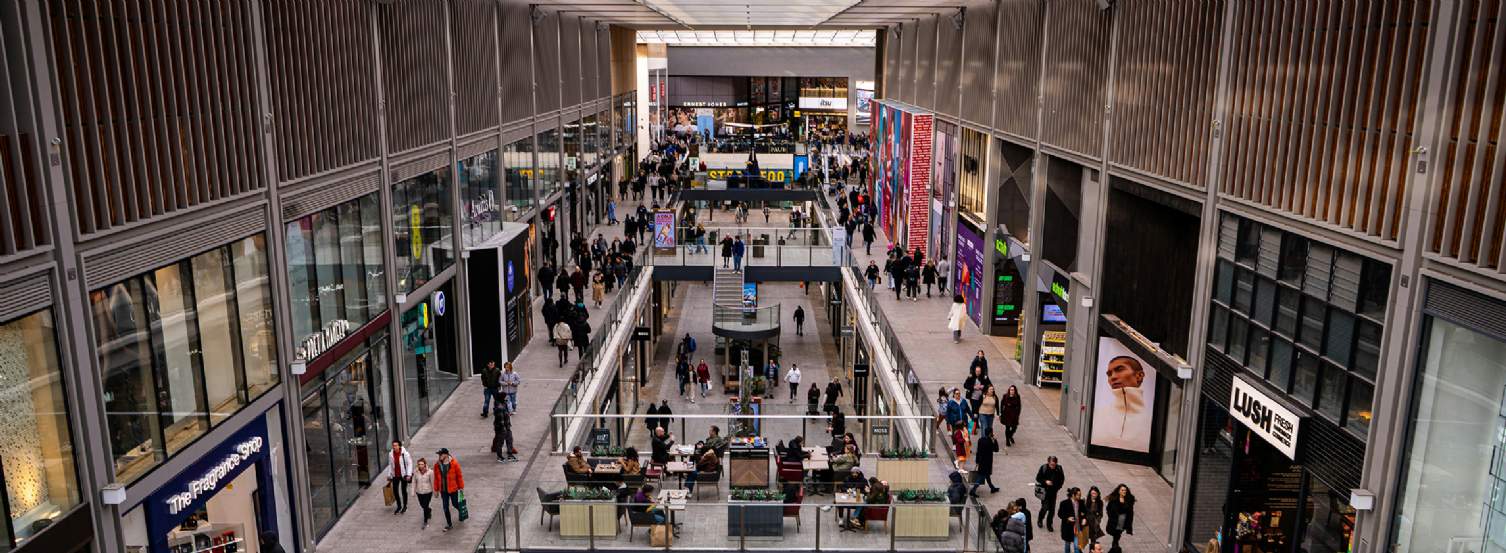
Resilient demand and improving confidence support renewed momentum.
A steady Christmas shaped by value and selective spending
Historical evidence points to resilience
Christmas has historically proved resilient for UK retailers, and the long-run evidence points to a steady rather than exceptional outcome in 2026. Since 1996, December retail sales excluding automotive fuel (ONS) have increased by an average of 2.0% a year in volume terms and 3.4% in value terms. December volumes were lower than a year earlier in only five of the past 30 years and values in just one, underlining consumers' tendency to protect festive spending even when economic conditions are challenging.
Inflation and consumer confidence provide the clearest guide to this year's prospects. Historically, retail sales volumes have weakened as inflation has risen, with a correlation of -0.73 between December CPI and volume growth: when inflation exceeded 4%, volumes fell by an average of 2.6%, compared with 4.0% growth when inflation was below 2%. Consumer confidence has been the strongest positive indicator, with a correlation of +0.63, whereas Bank of England (BoE) interest rates show no reliable independent relationship with festive sales, instead influencing trading indirectly through household finances, inflation and sentiment.
The current backdrop sits between these historical extremes. CPI inflation rose from 3.1% in August to 3.5% in September, remaining within the 2–4% range historically associated with modest December volume growth of 1.2%. The increase was driven principally by transport, particularly motor fuels, reinforcing the continued pressure on household budgets. Confidence has nevertheless improved: PwC's Consumer Sentiment Index moved into positive territory during the summer for the first time in five years, while 39% of consumers reported having money left at the end of the month for discretionary spending or savings.
Compared with Christmas 2025, stronger consumer confidence still points to trading broadly in line with last year, although September's increase in inflation has reduced some of the upside. Volume growth is likely to remain below its long-run average, with value growth continuing to run ahead as consumers remain sensitive to higher prices.
Confidence is improving, but spending remains selective
Recent consumer confidence data reinforces expectations of a steady, rather than exceptional, Christmas. The NIQ/GfK Consumer Confidence Index improved to -13 in September, 12 points above April's low of -25 and its third consecutive monthly increase. Personal finances over the previous 12 months improved to -3, while expectations for the year ahead remained positive at +5. By contrast, perceptions of the wider economy remain firmly negative, at -36 for the past year and -22 for the year ahead.
This distinction is important. Consumers appear increasingly confident in their ability to manage economic uncertainty rather than materially more optimistic about the economy itself. The Savings Index rose five points to +27, while the Major Purchase Index slipped to -8, suggesting improving sentiment has yet to translate into stronger discretionary spending.
Consumers are increasingly confident in their ability to manage uncertainty, but that confidence has yet to translate into stronger discretionary spending.
Sam Arrowsmith, Director, Commercial Research
Inflation therefore remains the principal sensitivity. At 3.5%, September’s CPI reading was the highest since October 2025, with transport, particularly motor fuels, making the largest upward contribution. Core CPI also increased from 2.6% to 2.8%, while services inflation rose from 3.4% to 3.7%. Although this remains materially different from the inflation shock of 2022–23, the renewed increase reinforces the pressure on household budgets and helps explain why improving confidence has yet to translate into stronger discretionary spending.
Historically, inflation in the 2–4% range has been consistent with modest positive retail volume growth rather than outright contraction. For high streets and shopping centres, this still points to a resilient rather than weak Christmas, but with spending remaining highly selective. Gifting, fashion, beauty, hospitality, leisure and affordable indulgences should prove more resilient than major discretionary purchases, favouring destinations offering a strong combination of value, convenience and experience.

Black Friday will concentrate festive spending
Shoppers' intentions also suggest Christmas itself will remain relatively well protected. Research from the Institute of Practitioners in Advertising found that 49% of consumers do not intend to cut back on any aspect of Christmas, up from 42% in 2025, while expected average spending has increased to £647. However, 45% expect to feel more financially anxious because of rising costs.
Black Friday, on 27 November, will consequently play an important role. More than 70% of those shopping during Black Friday in 2025 used promotions to purchase Christmas gifts, according to Mintel. Some 34% of consumers now buy Christmas gifts in November and a further 26% in December, creating an increasingly compressed and promotion-led peak.
Value will be central. Some 22% expect to spend up to half their Christmas budget during Black Friday, up from 16% last year, while free delivery, discounts, price matching and free returns are important influences on retailer choice. 15% expect to use credit cards to help fund Christmas and 14% plan to use buy now, pay later, compared with 9% two years ago.
For retailers and destinations, value will remain crucial, with targeted promotions and affordable premiumisation helping to capture selective festive spending without unnecessarily sacrificing margins. High streets and shopping centres combining competitive price points with gifting, food and beverage, leisure and engaging stores should be best placed to benefit.

The Budget is the bigger risk beyond Christmas
Interest rates and fiscal policy could still change the picture. The BoE held Bank Rate at 3.75% in September, although three members favoured an increase to 4.0%. Expectations have subsequently shifted towards the possibility of further tightening as energy-related inflation has intensified, with the next policy decision due on 5 November.
While an increase late in the year would have little direct impact on Christmas trading, it could quickly alter consumer sentiment and spending intentions heading into 2027, particularly among households facing mortgage refinancing or relying on consumer credit, reinforcing precautionary saving and weighing further on major purchase intentions.
The 28 October Budget is potentially more significant for the occupational outlook. Its immediate effect on festive spending may be limited, but changes affecting employment taxes, business rates or household finances could influence operator costs, investment and consumer confidence.
The British Retail Consortium estimates the retail sector's business tax bill will reach £41 billion in 2026/27, 20% higher than two years earlier, while retail employment has fallen by 122,000 jobs over the same period. Retail and hospitality also account for almost a third of business rates revenue, highlighting the particular exposure of property and labour-intensive operators. These are industry estimates, but they illustrate the scale of operator concern surrounding the cumulative cost burden.
A neutral or supportive Budget would allow household finances and confidence to continue supporting expenditure while giving retailers greater capacity to invest in stores, staff and technology. Additional costs could instead constrain investment and recruitment and increase selectivity over expansion and lease commitments. The Budget therefore matters less to Christmas sales in isolation than to the durability of the recovery into 2027.
Rental growth has paused rather than reversed
Rental growth points to an occupational market that remains resilient, but where momentum has moderated as occupiers become increasingly selective. Savills analysis of open-market lettings and regears showed average headline and net effective rents increasing by 2.3% and 2.5% year on year respectively in Q2 2026. However, on a rolling four-quarter basis, they softened by 6.2% and 6.8% compared with Q1 as the weaker leasing environment at the beginning of the year fed through.
The loss of momentum became clearer in Q3. Average headline rents fell 1.5% year on year and net effective rents by 1.9%, with the rolling four-quarter measures coincidentally recording the exact same respective falls from Q2. Average UK headline and net effective rents consequently returned to their levels of 12 months earlier, at £28.09 and £26.93 per sq ft respectively.
Occupiers remain prepared to compete for strategically important space in prime Central London locations, leading shopping centres and other supply-constrained markets, while seeking greater flexibility or incentives elsewhere.
Sam Arrowsmith, Director, Commercial Research
This is more consistent with renewed caution than a material deterioration in demand. Inflation, energy and fuel costs, interest rates and uncertainty ahead of the Budget are restricting the rents some businesses can sustainably support and encouraging greater discipline over acquisitions.
The result is increasing polarisation. Occupiers remain prepared to compete for strategically important space in prime Central London locations, leading shopping centres and other supply-constrained markets, while seeking greater flexibility or incentives elsewhere. Net effective rents can therefore soften even where landlords protect headline tone through rent-free periods, capital contributions or stepped rents.
Shopping centre vacancy reflects a stop-start recovery
Shopping centre vacancy illustrated the same stop-start recovery. It fell 80 basis points (bps) to 16.1% in Q2, the strongest quarterly improvement since Q1 2016, reversing the Q1 increase to 16.9%. Deferred leasing decisions subsequently completing, retail warehouse occupiers considering shopping centre space because of limited supply, and the continued repurposing of surplus accommodation all contributed.
However, according to Green Street, vacancy increased by 40 bps to 16.5% in Q3, while high-street vacancy remained unchanged at 13.2%. The increase should not, in isolation, be interpreted as a reversal of the recovery. Shopping centre vacancy can be disproportionately affected by the failure, relocation or downsizing of relatively few large occupiers, while lengthy fit-outs create a lag between completed lettings and units being classified as occupied. The Q3 movement also followed an unusually strong Q2 and coincided with greater occupier caution ahead of the Budget and Christmas.
Nevertheless, it reinforces the divide between asset types. Dominant centres with strong catchments, high sales densities and diversified leisure and food and beverage offers should remain capable of capturing demand. Secondary centres containing structurally vacant large units, weaker footfall or significant capital requirements face a slower recovery.
Footfall remains broadly stable
Physical retail activity remained broadly stable during Q3, with MRI Software recording average weekly year-on-year footfall growth of 0.2% across high streets and 0.7% across shopping centres. The stronger shopping centre performance may partly reflect their weather-protected environments and broader mix of retail, food and beverage, leisure and services, while high-street footfall points to stability rather than meaningful growth, with performance likely to vary by catchment and offer.

Outlook: steady spending, selective expansion
Taken together, the evidence points to a resilient but measured festive period and an occupational market entering a period of consolidation rather than acceleration.
Consumers remain more confident than at the recent low and appear determined to protect Christmas spending. However, September's renewed rise in inflation, alongside still-weak major purchase intentions, points to continued caution over discretionary expenditure. Value growth should therefore continue to outperform volume growth, with spending concentrated around gifting, beauty, hospitality, leisure and affordable indulgence.
Increasingly, it will be asset quality, rather than the direction of the wider market alone, that determines performance.
Sam Arrowsmith, Director, Commercial Research
That same selectivity is visible in the occupational market. Store openings, broadly stable footfall and competition for the best space continue to support demand, but flat annual rents and the Q3 increase in shopping centre vacancy demonstrate how sensitive occupiers remain to location and cost.
A benign Budget and steady Christmas could release further requirements and support renewed rental growth during 2027. Conversely, higher business costs, persistent inflation or renewed monetary tightening would weigh on profitability and expansion.
The result is unlikely to be a uniform recovery. The strongest high streets and shopping centres should remain supported by constrained availability, strong catchments and diversified offers, while secondary assets will require greater flexibility, investment and repositioning. Increasingly, it will be asset quality, rather than the direction of the wider market alone, that determines performance.
Key consumer & occupational takeaways
- A resilient but measured Christmas is the most likely outcome. December retail sales volumes have increased in 25 of the past 30 years, averaging 2.0% annual growth, but 2026 volume growth is likely to remain below this long-run average, with value growth continuing to run ahead.
- Consumer confidence is recovering, although spending remains selective. NIQ/GfK confidence improved from -25 in April to -13 in September, while expectations for personal finances remain positive at +5. However, the Major Purchase Index remains at -8, pointing to continued caution towards larger discretionary purchases.
- Inflation remains the principal risk to festive spending. CPI rose from 3.1% in August to 3.5% in September, its highest rate since October 2025. Historically, inflation of 2–4% has been associated with modest December volume growth of 1.2%, supporting a steady rather than exceptional outlook.
- Consumers remain determined to protect Christmas spending, but value will be critical. 49% do not intend to cut back on any aspect of Christmas, up from 42% in 2025, although 45% expect to feel more financially anxious. Black Friday will be particularly important, with 22% expecting to spend up to half their Christmas budget during the promotional period.
- Physical retail remains well placed to capture festive demand. MRI recorded Q3 footfall growth of 0.2% across high streets and 0.7% across shopping centres. Destinations offering a strong combination of retail, food and beverage, leisure and experiences should be best positioned to capture increasingly selective expenditure.
- Occupational momentum has moderated rather than reversed. Q3 headline and net effective rents fell 1.5% and 1.9% year on year, respectively, while shopping centre vacancy increased from 16.1% to 16.5%. Rising fuel and energy costs have added to occupier caution, although demand for the best space remains resilient, pointing towards increasing polarisation rather than broad-based weakness.
- Asset quality will increasingly determine performance. Prime high streets and dominant shopping centres with strong catchments, appropriate space and compelling retail, leisure and service offers remain best placed to outperform. The Budget, inflation and interest-rate outlook will be key to whether improving consumer and occupier confidence translates into renewed momentum during 2027.
UK shopping centre investment: Higher volumes, but liquidity remains selective
Q3 rebound lifts year-to-date volumes
The UK shopping centre investment market regained momentum during Q3 2026, with £388.7 million transacted across ten deals, broadly in line with Q3 2025 and a sharp recovery from the unusually subdued second quarter. This took volumes for the first nine months to £910.0 million across 20 transactions, 9.2% above the £833.0 million recorded over the equivalent period of 2025.
The rebound is significant given Q2 delivered just £94.8 million across five transactions, only the second quarter since Q2 2020 in which volumes had fallen below £100 million. It also supports the argument made in our Q2 Spotlight that the market was “poised, not paused”, with subdued volumes understating the depth of the pipeline.
However, activity continues to be characterised by short bursts of liquidity rather than a consistently deep transactional market. A relatively small number of major transactions are driving the recovery, with Manchester Arndale, Merry Hill and The Broadway, Bradford accounting for almost two-thirds of investment during the first nine months.
Major transactions bring institutional capital back at scale
The defining transaction of Q3 was Hammerson’s acquisition of a 50% stake in Manchester Arndale for £218 million, completed on 30 July. The stake was acquired from the former Intu revolving credit facility investors at a topped-up net initial yield of 7.8%, with M&G Real Estate retaining its existing 50% interest.
The acquisition is significant not only because of its scale, accounting for more than half of Q3 investment volumes, but also because it represents Hammerson’s first major external acquisition in more than a decade. Its willingness to raise equity to fund the transaction provides further evidence that listed capital is prepared to increase its exposure to the strongest retail destinations where asset quality, income growth and long-term strategic relevance can be demonstrated.
Momentum has continued into Q4 when Landsec announced that it had exchanged contracts to acquire a 100% interest in Metrocentre, Gateshead, for a headline price of £530 million. The price reflects a net initial yield of 7.78%, with completion expected by the end of October, subject to the outstanding conditions being satisfied. This represents precisely the type of asset attracting the strongest institutional interest: large, dominant, well-invested and capable of supporting substantial debt and equity deployment.
Landsec reinforced this strategy on 13 October, completing the acquisition of a further 10% interest in Bluewater for £95 million, reflecting a 7.4% yield based on the net rental income generated by its existing investment. The transaction increased Landsec’s ownership of the centre to 74.0%, providing further evidence of its willingness to increase exposure to dominant, high-performing retail destinations.
Headline volumes are therefore recovering more quickly than underlying liquidity across the wider market.
Toby Ogilvie Smals, Director, Retail Investment
These transactions demonstrate the renewed appetite for dominant, institutionally relevant shopping centres, but also the concentration of that demand. Manchester Arndale, Metrocentre, Bluewater and Merry Hill represent more than £1.1 billion of investment, equivalent to approximately 69% of the market. Headline volumes are therefore recovering more quickly than underlying liquidity across the wider market.
This concentration is not necessarily a weakness. Larger lot sizes were expected to play a central role in the sector's recovery and major transactions provide valuable pricing evidence and confidence. However, annual volumes alone increasingly overstate the extent to which conditions have improved for the average shopping centre asset.
Larger assets attract a broader pool of capital
The shift towards larger transactions identified in Q2 has strengthened. Transactions below £25 million account for 12 of the 26 deals completed year to date, or 46% by number, materially below the 73% average recorded since 2021. Average lot sizes are consequently moving higher, reversing some of the fragmentation seen when institutional capital retreated and activity became concentrated among smaller private-equity and property-company buyers.
This marks an important change in the cycle. Listed and institutional investors are again prepared to deploy substantial capital into shopping centres, but demand remains highly selective. Buyers are concentrating on dominant catchments, resilient and diversified income, strong occupational fundamentals and assets offering credible opportunities to drive future value.
Financing reinforces this trend. Major lenders generally prefer to deploy £50 million to £150 million debt tickets rather than £10 million to £15 million against smaller assets, supporting greater competition for larger schemes. At the upper end, buyers including Landsec, Hammerson and Realty Income have the capital, expertise and access to debt required to acquire and manage major regional destinations.
Listed and institutional investors are again prepared to deploy substantial capital into shopping centres, but demand remains highly selective.
Mark Garmon-Jones, Director, UK Investment
Liquidity is more constrained at the smaller end of the market, particularly for assets below approximately £40 million. Above this level, there is generally a reasonable depth of demand, with larger lot sizes increasingly attracting institutional and well-capitalised buyers. Below £40 million, the buyer pool is more reliant on private equity, overseas capital and specialist property companies, making liquidity more selective.
The market is therefore increasingly segmented by lot size and buyer type. Larger, best-in-class centres can attract institutional capital at scale, while smaller assets need to offer sufficiently attractive income returns or a clear and deliverable asset-management opportunity to generate competitive demand. For these smaller assets, appropriate pricing is particularly important to achieving liquidity.
Beyond lot size, demand is also strongest for well-let schemes offering secure, durable income or assets presenting a clear, costed and deliverable route to value creation. Long-dated income alone is insufficient where buyers identify obsolescence or reletting risk, while material vacancy can constrain financing where the path to stabilisation is uncertain.
Pricing remains highly asset-specific
Savills shopping centre equivalent yields remain unchanged for a fifth consecutive quarter at 7.25% for Super Prime, 9.00% for Prime and 10.50% for Town Centre Dominant assets. However, stability in the headline series masks considerable variation according to dominance, location, income quality, capital expenditure and the credibility of the underlying business plan.
Fourteen schemes are currently under offer, representing approximately £400 million of capital value, at an average net initial yield of 9.7% and average capital value of £28.6 million. A further 24 centres are being marketed with a combined quoting value of approximately £672 million, an average quoting yield of 8.65% and average capital value of £29.2 million.
Yield averages should nevertheless be treated with caution. Capital expenditure, vacancy and future income resilience can vary materially between superficially similar centres, making yield alone an increasingly imperfect measure of relative value. Appropriate pricing remains particularly important for smaller and secondary assets, where the depth of demand can be more limited.
There is also a behavioural dimension to pricing. Institutional investors may accept that a vendor has generated a profit where an asset is demonstrably stronger, while more opportunistic buyers can be resistant to paying materially above an earlier acquisition price, particularly where they considered the same asset during its previous sale. This could influence execution as assets acquired by private equity during 2021 and 2022 begin to return to market.
A £1 billion-plus pipeline supports activity into 2027
The immediate pipeline remains substantial. The 14 shopping centres under offer at approximately £400 million, together with 24 centres being marketed at £672 million, represent more than £1 billion of potential transactions, although not all will complete in 2026.
This provides sufficient depth to support Savills full-year investment forecast of £1.5 billion to £2.0 billion, even allowing for some transactions to move into 2027. The longer-term pipeline could be more significant still, with eight of the UK's top 30 shopping centres potentially coming to market during 2027, including several former Intu assets.
If these processes proceed, the market would enter 2027 with an unusually strong supply of large, institutionally relevant opportunities and continue the structural shift in ownership identified in Q2. Assets and stakes unavailable for extended periods are moving towards listed companies, institutions, private equity and overseas investors with fresh capital and more active management strategies.
Timing remains uncertain, however. Where leasing, operational or redevelopment initiatives have further to run, vendors may choose to extend hold periods rather than sell. There is also relatively little distress or bank-led stock, with product more likely to come forward through planned exits and capital recycling than forced selling.

Debt remains supportive, but less of a tailwind
The debt market remains supportive for the strongest assets, although the position is less favourable than in Q2. Higher five-year SONIA swap rates and changing interest-rate expectations have reduced some of the earlier financing support. Debt remains available for dominant, well-performing centres and lender appetite for larger tickets remains strong, but higher benchmark rates are placing greater pressure on leveraged returns where yields are tighter or capital expenditure requirements substantial.
There is little evidence of this triggering broad prime repricing. Manchester Arndale, at a 7.8% topped-up NIY, illustrates investors' continued willingness to deploy substantial capital into high-quality assets. The impact is more pronounced where the investment case is less clear, as higher debt costs can quickly widen the gap between vendor expectations and buyer pricing.
Consumer and occupier risk have also returned to the underwriting. Higher energy, fuel and mortgage costs, alongside uncertainty surrounding the Budget, are prompting investors to stress-test income against weaker sales, higher operating costs and occupier failure.
The implications remain highly asset-specific. Dominant centres with diversified occupier mixes, strong catchments, constrained competing supply and robust occupational demand are better positioned to absorb softer consumer conditions. Schemes reliant on narrower discretionary occupier bases, or requiring significant near-term capital expenditure, face greater scrutiny.
Outlook: Higher volumes, but a two-speed recovery
The shopping centre market has moved forward since Q2. The anticipated second-half pipeline has begun to convert, institutional capital is deploying at scale and two of the UK's most significant shopping centres have attracted listed buyers.
This supports a more constructive view of the sector than the subdued Q2 figures initially suggested. Full-year volumes are likely to reach £1.5 billion to £2.0 billion, with £910 million already transacted during the first nine months and the Metrocentre acquisition providing a further £530 million boost to Q4 volumes. A further £400 million remains under offer, providing scope for activity to approach the upper end of the forecast range if execution remains on track. Landsec’s Metrocentre acquisition is expected to complete by the end of October, subject to the remaining conditions.
However, the nature of the recovery requires careful interpretation. Headline volumes have strengthened, but activity remains concentrated among a relatively small number of large transactions. Manchester Arndale, Metrocentre and Merry Hill together account for the majority of capital committed during the year, although demand is generally healthy for assets above approximately £40 million, with liquidity becoming more selective below this level.
The central question is therefore no longer whether institutional capital will invest in shopping centres. Manchester Arndale and Metrocentre have provided clear evidence that it will. The more important test is how widely this demand broadens and whether smaller assets can attract sufficient competitive tension, particularly where pricing, income security or the route to value creation is less compelling.
The outlook for prime and dominant centres remains supportive. Scarcity, improving occupational performance and access to debt should limit outward yield pressure, even as higher benchmark rates temper the prospect of near-term compression. Super Prime yields also remain significantly above their long-term average, providing a supportive backdrop for the future trajectory of these assets. Across the wider market, performance will remain more asset-specific, with liquidity determined by pricing, income security, capital expenditure and the clarity of the business plan.
Looking into 2027, the potential release of further top-30 centres, including former Intu assets, could sustain volumes and accelerate the structural transfer of ownership. It will also provide a more meaningful test of buyer depth. A market offering several large opportunities simultaneously may expose the limits of a still relatively concentrated pool of institutional capital.
The direction of travel remains positive, but liquidity will continue to vary by lot size and asset quality. Demand is generally healthy above approximately £40 million, with dominant destinations attracting institutional capital at scale, while liquidity becomes more selective below this level. For vendors, realistic pricing and preparation will be critical, particularly for smaller assets. For buyers, opportunities remain, but increasingly depend on identifying assets where occupational resilience and active management can offset a less supportive debt and consumer backdrop.
Key shopping centre investment takeaways
- Shopping centre investment has regained momentum, but the recovery remains concentrated. Q3 volumes reached £388.7 million, taking investment for the first nine months to £910.0 million, 9.2% ahead of 2025 and a significant rebound from the £94.8 million recorded in Q2.
- Large transactions are driving the recovery. Manchester Arndale, Merry Hill and The Broadway, Bradford accounted for almost two-thirds of investment during the first nine months, while the £530 million Metrocentre acquisition in Q4 provides a significant further boost to full-year volumes and reinforces the growing influence of larger lot sizes.
- Institutional capital has returned, but selectively. Metrocentre, Bluewater, Manchester Arndale and Merry Hill alone represent more than £1.1 billion of investment, equivalent to approximately 69% of the market, demonstrating the concentration of institutional demand in large, dominant destinations.
- Liquidity is increasingly differentiated by lot size and asset quality. Demand is generally healthy for assets above approximately £40 million, while liquidity is more selective below this level. Smaller assets therefore need to offer attractive income returns, realistic pricing or a clear and deliverable route to value creation to generate competitive demand.
- Pricing remains stable, but increasingly asset-specific. Savills equivalent yields remain at 7.25% for Super Prime, 9.00% for Prime and 10.50% for Town Centre Dominant centres. Super Prime yields also remain significantly above their long-term average, providing a supportive backdrop for the future performance of these assets. Assets under offer average a 9.7% NIY, compared with an 8.65% average quoting yield for those being marketed, reinforcing the importance of appropriate pricing, particularly for smaller and secondary assets.
- The pipeline supports further growth. Fourteen centres worth approximately £400 million are under offer, with another 24 totalling £672 million being marketed. This supports Savills’ £1.5 billion to £2.0 billion full-year forecast, while the potential release of eight of the UK’s top 30 centres in 2027 could sustain momentum.
UK high street investment: Capital remains available, but volume is constrained by stock
MSCI RCA data records £747.3 million of urban retail and high street transactions across Q1-Q3 2026, although further transactions may yet be captured as reporting catches up. On the current data, volumes sit 52.7% below the £1.58 billion recorded over the same period in 2025. While the headline points to a quieter year, transaction activity continues to be influenced more by a lack of available stock than by any fundamental weakening in investor demand.
Indeed, the key characteristic of the market remains the depth and diversity of capital targeting the sector. High streets continue to benefit from one of the broadest buyer pools across UK retail, with private investors, family offices, overseas capital and selective institutional buyers all active. Importantly, a significant proportion of this capital is seeking secure day-one income rather than relying on a near-term capital growth story, a characteristic that has helped support liquidity despite ongoing uncertainty around inflation, interest rates and fiscal policy.
High streets continue to benefit from one of the broadest buyer pools across UK retail, with private investors, family offices, overseas capital and selective institutional buyers all active.
Sam Arrowsmith, Director, Commercial Research
The improved flow of opportunities that emerged towards the end of Q2 has continued into Q3, although deal activity remains highly selective. Investors are increasingly accepting that the geopolitical and macroeconomic backdrop is unlikely to improve materially in the near term and are showing a greater willingness to transact accordingly. For many buyers, the focus has shifted from waiting for greater certainty to identifying assets capable of delivering sustainable income through a range of economic scenarios.
Pricing remains stable
Prime equivalent yields remain at 6.50%, where they have stood since the 25 bps compression recorded in July 2024. The absence of any material outward yield movement is notable given the renewed volatility in inflation expectations, energy prices and interest rate forecasts over recent months.
Pricing stability continues to be supported by a combination of constrained supply and a buyer base that is less dependent on institutional investment committee cycles than other retail sub-sectors. Best-in-class stock remains tightly held, while the predominantly private nature of demand across much of the market provides a degree of insulation from short-term fluctuations in market sentiment.
As a result, any pricing pressure is generally confined to larger lot sizes where the buyer pool is inherently narrower, or to assets requiring significant leasing or capital expenditure. By contrast, well-let assets in strong locations continue to attract competitive interest, reflecting investors' ongoing preference for secure income and proven occupational fundamentals.
Occupational fundamentals continue to support investor interest
While occupier conditions have become more challenging as retailers respond to rising operating costs and uncertainty ahead of the Budget, the occupational backdrop remains considerably healthier than many headline narratives suggest. Rental growth has moderated but prime locations continue to benefit from limited availability and tenant demand remains focused on the strongest pitches.
For investors, this distinction is important. Current demand is underpinned less by expectations of rapid rental growth and more by confidence in the durability of income streams and the continued relevance of the best high street locations. As a result, well-capitalised buyers continue to view periods of negative occupier sentiment as potential acquisition opportunities rather than a reason to step back from the market.

Outlook
The outlook remains cautiously positive. Transaction volumes may remain below historic norms in the near term, but this is more likely to reflect limited stock availability than a shortage of capital. Investor appetite for high streets remains supported by attractive income returns, stable pricing and one of the most diverse buyer pools in UK retail.
Assuming inflation and interest rate expectations remain broadly contained, prime yields are expected to remain stable over the coming quarters. While economic and political uncertainty may continue to influence transaction timing, the sector enters 2027 with capital available, occupational fundamentals broadly supportive and investors increasingly prepared to transact despite an imperfect backdrop.